


















Table of Contents
A 50000mAh power bank sits at a sweet spot between everyday portable chargers and bulky power stations. It’s large enough to run serious devices like portable fridges or CPAP machines, yet still compact enough for camping, fishing, travel, and emergency use.
But what can a 50000mAh power bank really power? And how long does it actually last in real-world conditions?
This guide breaks it all down—clearly, honestly, and with real runtime calculations.
Quick Answer: What Can a 50000mAh Power Bank Power?
A high-quality 50000mAh power bank can typically power:
Smartphones (8–12 full charges)
Tablets (4–6 charges)
Laptops (1–2 full charges)
LED camping lights (10–40+ hours)
CPAP machines (1–2 nights, DC mode)
Portable 12V fridges (6–12 hours, cycling)
👉 Actual runtime depends on watt-hours (Wh), output type (DC vs AC), and efficiency—not just mAh.
What Does “50000mAh” Really Mean?
This is where many users get confused.
mAh vs Wh: The Key Difference
mAh (milliamp-hours) measures capacity at a specific voltage
Wh (watt-hours) measures actual usable energy
Most lithium batteries are rated at 3.6–3.7V, so:
50000mAh × 3.7V ≈ 185Wh
That means a real 50000mAh power bank usually delivers 180–190Wh of energy.
👉 If a product does not clearly list Wh, treat the capacity claim with caution.
How Long Does a 50000mAh Power Bank Last?
Basic Runtime Formula
Runtime (hours) = Battery Wh × Efficiency ÷ Device パワー (W)
Typical efficiency:
DC output: 90–95%
USB output: 85–90%
AC output: 75–85% (due to inverter loss)
Real Runtime Examples: What Can It Power?
Let’s assume a 185Wh power bank with good DC efficiency.
1. Smartphones & Tablets
| Device | Battery Size | Estimated Charges |
|---|---|---|
| Smartphone | 4,500mAh | 9–12 times |
| Tablet | 8,000mAh | 4–6 times |
USB output losses are minimal, making this one of the most efficient uses.
2. Laptop Charging (USB-C PD or DC)
| Laptop Power Draw | Runtime |
|---|---|
| 45W ultrabook | ~3.5–4 hours |
| 65W laptop | ~2.5–3 hours |
| 100W workstation | ~1.5–2 hours |
👉 USB-C PD and DC charging outperform AC adapters in efficiency.
3. Portable Fridge (12V DC)
Typical compressor fridge:
Average draw: 40–60W
Duty cycle: ~30–50%
| Scenario | Runtime |
|---|---|
| Mild weather | 10–12 hours |
| Hot weather | 6–8 hours |
👉 DC output is critical—AC inversion can reduce runtime by 20–30%.
4. CPAP Machine (DC Mode)
Typical CPAP power:
Without humidifier: 30–40W
With humidifier: 60–90W
| Mode | Runtime |
|---|---|
| DC only (no humidifier) | 8–10 hours |
| With humidifier | 4–6 hours |
Many modern CPAP machines support 12V or 24V DC input with dedicated cables, making power banks far more efficient than AC solutions.
5. LED Lighting & Camping Gear
| Device | パワー | Runtime |
|---|---|---|
| LED strip | 10W | 16–18 hours |
| Camping lantern | 5W | 30+ hours |
| Router / Dashcam | 8–12W | 12–20 hours |
Why Output Type Matters: DC vs AC vs USB
| Output Type | Efficiency | Best For |
|---|---|---|
| USB | High | Phones, tablets |
| DC (12V/24V) | Very High | Fridges, CPAP, lighting |
| AC | Medium | AC-only devices |
DC output delivers power directly—no conversion loss, less heat, longer runtime.
This is why outdoor-focused power banks prioritize DC outputs over large AC inverters.
What a “Real” 50000mAh-Class Power Bank Looks Like
A legitimate high-capacity power bank should clearly specify:
Watt-hours (Wh)
Battery chemistry (Li-ion or LiFePO4)
Output voltages (USB, 12V, 24V DC)
BMS protection features
Merpower GP Series (Example)
Merpower’s outdoor power banks are designed around real energy delivery, not inflated mAh numbers.
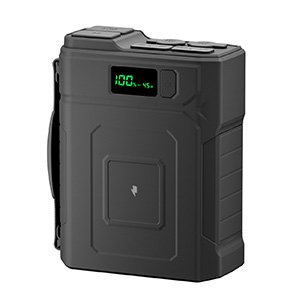
GP16 – Compact, travel-friendly, USB-C + DC outputs
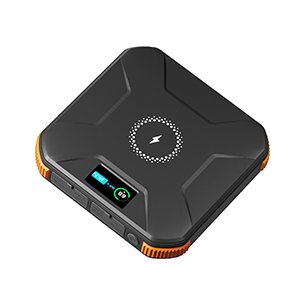
GP20 – Mid-capacity, 12V DC socket, ideal for camping and fishing
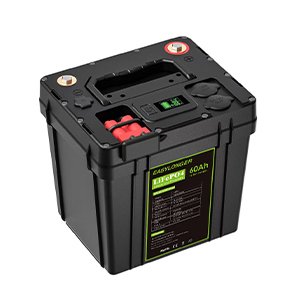
GP50 – High-capacity LiFePO4 model for extended outdoor use and backup
These models emphasize DC efficiency, safety, and realistic runtime expectations.
50000mAh vs Other Capacities
| Capacity | Best Use |
|---|---|
| 20,000mAh | Daily commuting |
| 30,000mAh | Weekend trips |
| 50,000mAh | Camping, CPAP, fridge |
| 100,000mAh+ | Base camp, power stations |
👉 50000mAh is often the best balance of portability and usable power.
Airline & Safety Considerations
Most airlines limit carry-on batteries to ≤100Wh
50000mAh (~185Wh) usually cannot be carried onboard
LiFePO4 batteries offer:
Longer cycle life
Better thermal stability
Enhanced safety
Always check airline regulations before travel.
Who Should Choose a 50000mAh Power Bank?
This capacity is ideal if you:
Camp or fish overnight
Use a CPAP machine
Run a portable fridge
Need silent emergency backup
Want serious power without a bulky generator
Frequently Asked Questions
Is a 50000mAh power bank worth it?
Yes—if you power devices beyond phones and tablets.
Can it replace a power station?
For short trips and DC-powered gear, often yes.
Why not just use AC?
AC wastes energy. DC gives longer runtime.
Is mAh or Wh more important?
Wh—always Wh.
Conclusion: Is a 50000mAh Power Bank Enough?
A 50000mAh power bank delivers meaningful, usable energy—when it’s honestly rated and properly designed.
If you understand:
Watt-hours
Output efficiency
Your device power needs
…it becomes one of the most versatile portable power solutions available today.
For outdoor use, emergency backup, and mobile living, 50000mAh isn’t just big—it’s smart.