
















A Better Day on Coastal Water: Inshore Fishing, Essential Gear, and Portable Power
Inshore fishing is one of the most accessible ways to begin saltwater fishing.
You can fish from a beach, pier, jetty, kayak, skiff, or small center-console boat. Trips are often shorter than offshore excursions, and the tackle is usually lighter. Bays, estuaries, grass flats, tidal creeks, mangrove shorelines, and coastal channels can all provide productive fishing.
Accessibility, however, should not be confused with simplicity.
A successful inshore trip still requires an understanding of tides, weather, fish habitat, local regulations, safety equipment, and onboard power. Phones, fish finders, radios, cameras, lights, and bait aerators all depend on reliable electricity. If their combined power requirements are not considered before departure, essential equipment may stop working before the trip is over.
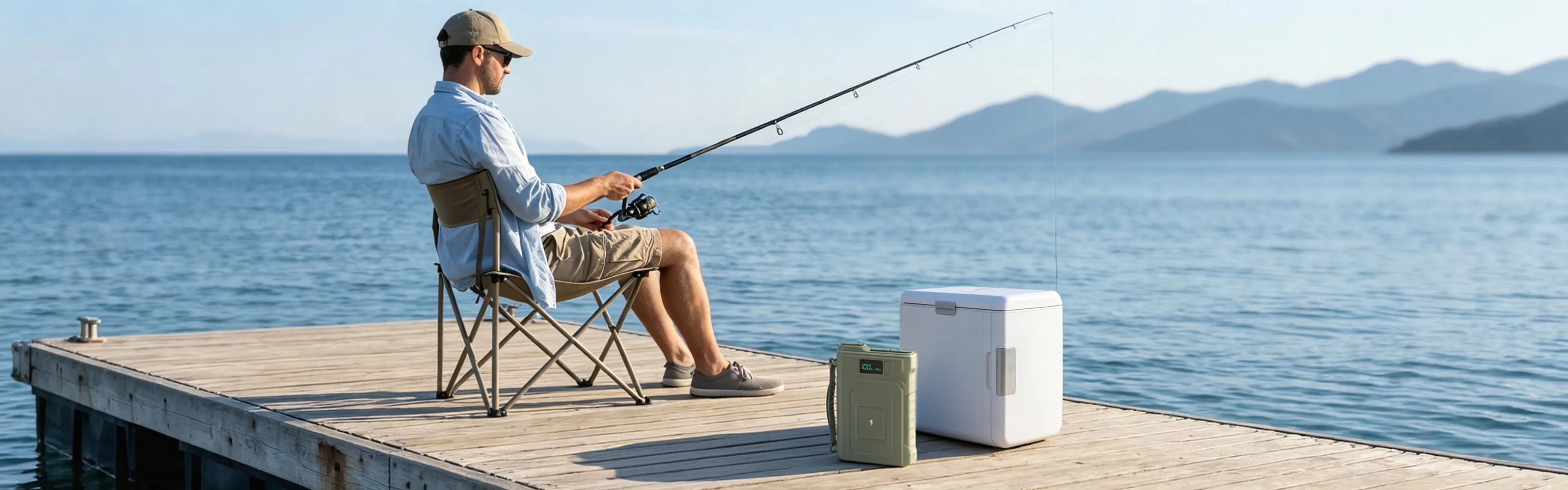
This guide explains where inshore fishing happens, how it differs from offshore fishing, which species anglers pursue along U.S. coasts, what equipment to carry, and how a portable power solution such as the Merpower GP45SE can support compatible electronics during a day on the water.
Reading the Water: Where Inshore Fishing Really Happens
There is no single distance from shore that defines every inshore fishing trip.
Some anglers use the term for fishing within a few miles of land. Others use it to describe protected saltwater environments, regardless of the exact distance. State boundaries, regional language, water depth, and fishing traditions can all influence the definition.
For a beginner, it is more useful to think about the type of water, boat, and fishing environment.
More Than a Fixed Distance From Shore
Inshore fishing commonly takes place in:
- Bays
- Estuaries
- Lagoons
- Tidal creeks
- Salt marshes
- Grass flats
- Mangrove shorelines
- Coastal rivers
- Piers
- Jetties
- Beaches
- Inlets
- Protected coastal channels
- Shallow reefs close to shore
These environments provide food, shelter, current, and temperature changes that attract fish.
An estuary, for example, mixes fresh water with salt water and can support baitfish, shrimp, crabs, and many popular gamefish. Grass flats create cover and feeding areas, while bridge pilings, docks, rocks, and oyster beds provide structure.
Learning to recognize these features is often more useful than measuring the distance to land.
Where Beginners Are Most Likely to Fish
Shorelines and piers provide a simple starting point because they do not require a boat. They allow new anglers to practice casting, rigging, bait presentation, and safe fish handling.
Kayaks and small boats provide access to flats, marshes, creek mouths, and other water that may be difficult to reach from land. They also introduce additional responsibilities, including navigation, personal flotation, weather monitoring, battery management, and safe equipment storage.
The right starting location depends on:
- Swimming ability
- Boating experience
- Weather
- Current
- Water depth
- Available safety equipment
- Target species
- Local access rules
Close to Land Still Requires a Safety Plan
A boat can encounter serious conditions without traveling far offshore.
Tidal currents may increase quickly around bridges, inlets, and narrow channels. Wind can make it difficult for a kayak or small boat to return. Thunderstorms may develop during warm afternoons, and fog can remove visible landmarks.
Before leaving, check:
- Weather forecast
- Wind speed and direction
- Tide times
- Current
- Storm probability
- Visibility
- Sunrise and sunset
- Local navigation hazards
Wear an appropriate life jacket and tell a reliable person where you are going and when you expect to return.
“Inshore” describes the fishing environment. It does not remove the need for preparation.
From Protected Bays to Open Water: How Inshore Trips Differ
The boundary between inshore, nearshore, and offshore fishing is not always precise. The practical differences involve distance, water conditions, boat requirements, target species, and the amount of preparation needed.
| Trip factor | Inshore fishing | Offshore fishing |
|---|---|---|
| Typical water | Bays, estuaries, flats and coastal channels | Open ocean and deeper water |
| Access | Beach, pier, kayak or small boat | Larger offshore-capable boat |
| Typical trip length | A few hours or a day | Often a full day or longer |
| Tackle | Light to medium, depending on species | Usually heavier tackle |
| Weather exposure | Sometimes protected, but still changeable | Greater open-water exposure |
| Navigation demands | Local channels and coastal navigation | Longer-range navigation |
| Power needs | Phone, fish finder, radio, camera and lights | More extensive navigation, communication and safety systems |
| Common targets | Redfish, flounder, seatrout and striped bass | Tuna, mahi-mahi, wahoo and billfish |
Why Inshore Fishing Is Easier to Enter
Inshore fishing can be more approachable because:
- Travel distances are usually shorter.
- Shore fishing does not require a boat.
- Smaller boats can reach many productive areas.
- Tackle may be lighter and easier to handle.
- Fuel and charter costs are generally lower.
- Beginners can focus on a smaller area.
- Trips can be planned around a few hours of favorable tide.
A shorter trip also makes it easier to test new equipment without committing to a full day far from shore.
What Changes When the Boat Goes Farther Out
As a boat leaves protected coastal water, it becomes more exposed to waves, wind, weather changes, and longer return distances.
Offshore planning may require:
- Greater fuel reserves
- Longer-range communication
- More navigation equipment
- Additional safety equipment
- Heavier fishing tackle
- More food and water
- Larger electrical capacity
- Backup systems
The conditions that were manageable near shore may become serious in open water.
The Middle Ground Called Nearshore Fishing
Nearshore fishing often refers to coastal water outside protected bays and estuaries but short of a true offshore trip.
Possible nearshore locations include:
- Artificial reefs
- Coastal wrecks
- Rock piles
- Buoys
- Channel edges
- Reefs within sight of land
A destination can be close to shore and still experience open-ocean waves or strong current. Plan around the actual conditions rather than the category used to describe the trip.
Plan the Power Before You Leave the Dock
Electronic equipment can improve navigation, fish finding, communication, photography, and safety. It can also create an overlooked source of risk if the battery plan is incomplete.
The best time to test a power system is before the boat leaves the dock.
Electronics That Support a Fishing Day
A typical inshore setup may include:
- Fish finder
- GPS or chartplotter
- VHF radio
- Mobile phone
- Action camera
- Underwater camera
- Bait aerator
- LED fishing light
- Headlamp
- Small compatible cooler
- USB accessories
These devices have different electrical requirements. A phone charges through USB, while a fish finder may require a specific DC voltage and connector. A cooler, pump, or aerator may draw more power when starting.
Why Auxiliary Electronics Need Their Own Power Plan
A boat’s starting battery should retain enough energy to start the engine. Using it throughout the day for phones, cameras, lights, and other accessories can reduce that reserve.
Depending on the boat and electrical system, a separate auxiliary supply may help support non-starting equipment.
A portable battery can also be useful for:
- Pier fishing
- Shore fishing
- Kayak launch areas
- Overnight fishing
- Photography
- Campsites
- Vehicle use before and after the trip
A separate battery does not eliminate the need to calculate power consumption. It simply provides another source that must be matched correctly to the connected devices.
Where the GP45SE Fits Into an Inshore Setup
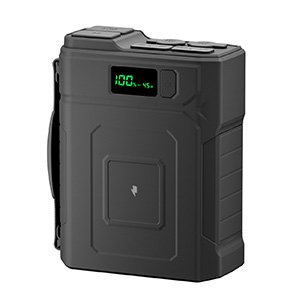
The Merpower GP45SE is a portable LiFePO4 battery pack designed to provide DC and USB power for compatible equipment.
Its main specifications include:
| GP45SE feature | Specification |
|---|---|
| Battery chemistry | LiFePO4 |
| Battery capacity | 12.8V, 30Ah, 384Wh |
| Cigar-lighter output | 10–14V, up to 10A |
| Big Anderson output | 10–14V, up to 25A |
| USB-C1 output | Up to 100W |
| USB-C2 output | Multi-voltage fast charging |
| USB-A output | Up to 18W |
| Solar charging input | MPPT support up to 100W |
| Additional feature | Built-in LED light |
| Portability | Integrated carrying handle |
For an inshore fishing trip, possible applications may include:
- A compatible fish finder
- Mobile phones
- Tablets
- Cameras
- Low-power LED fishing lights
- Compatible bait aerators
- USB accessories
- Communication equipment
- Other suitable DC devices
Compatibility must be checked before connection.
Match the Device Before Connecting It
Confirm the following information:
- Required voltage
- Normal current
- Maximum current
- Connector type
- Connector polarity
- Normal operating power
- Startup power
- Expected operating time
The fact that a device is described as “12V” does not guarantee compatibility with every 12V-class battery.
The GP45SE provides a 10–14V range through its cigar-lighter and Big Anderson outputs. The connected device must accept that range and remain within the current limit of the selected output.
If voltage regulation, a special adapter, or a different connector is required, use an approved solution that matches both products.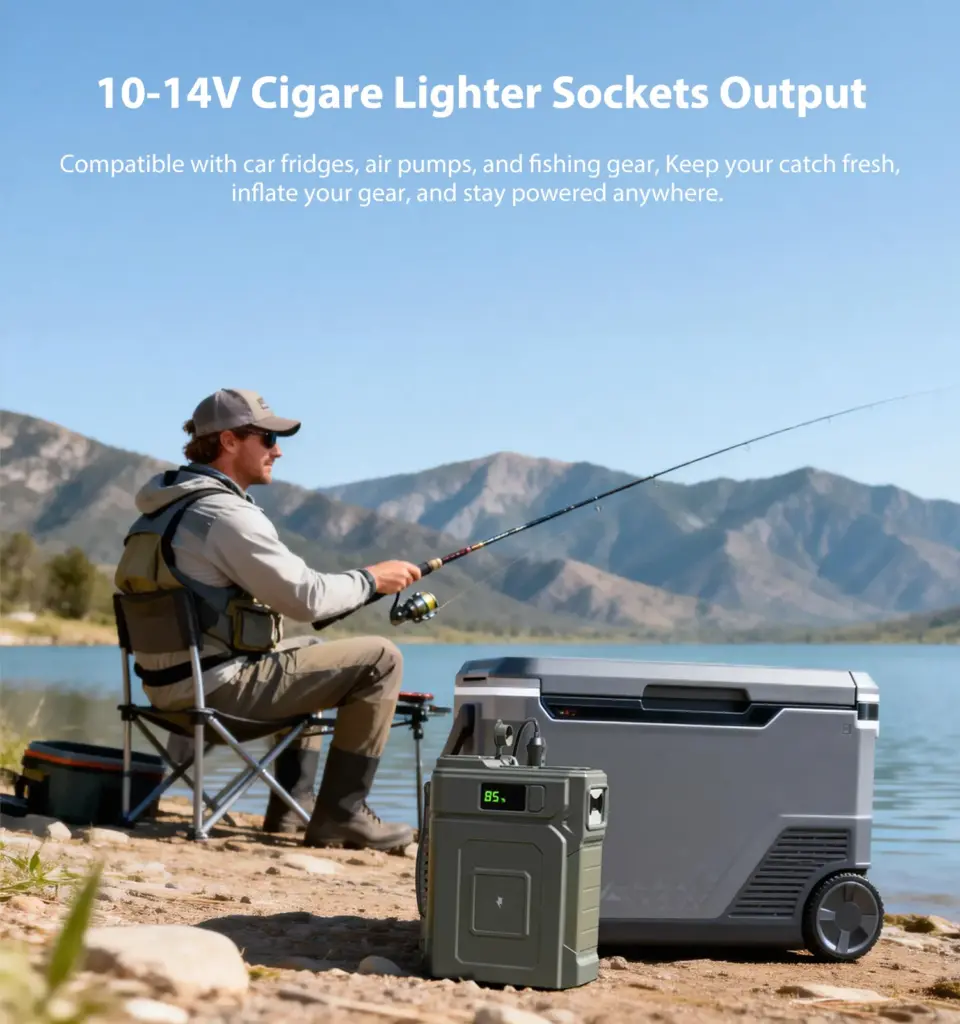
What the GP45SE Is Not Intended to Replace
The GP45SE should be presented as a portable auxiliary power source.
It should not automatically be treated as:
- An engine-starting battery
- A dedicated trolling-motor battery
- A permanently installed marine battery
- A replacement for the boat’s complete electrical system
- A waterproof or marine-grade battery
- The only power source for emergency communication
A trolling motor, for example, may require sustained high current and substantial total energy. Compatibility cannot be determined from nominal voltage alone.
Protect the GP45SE From Saltwater
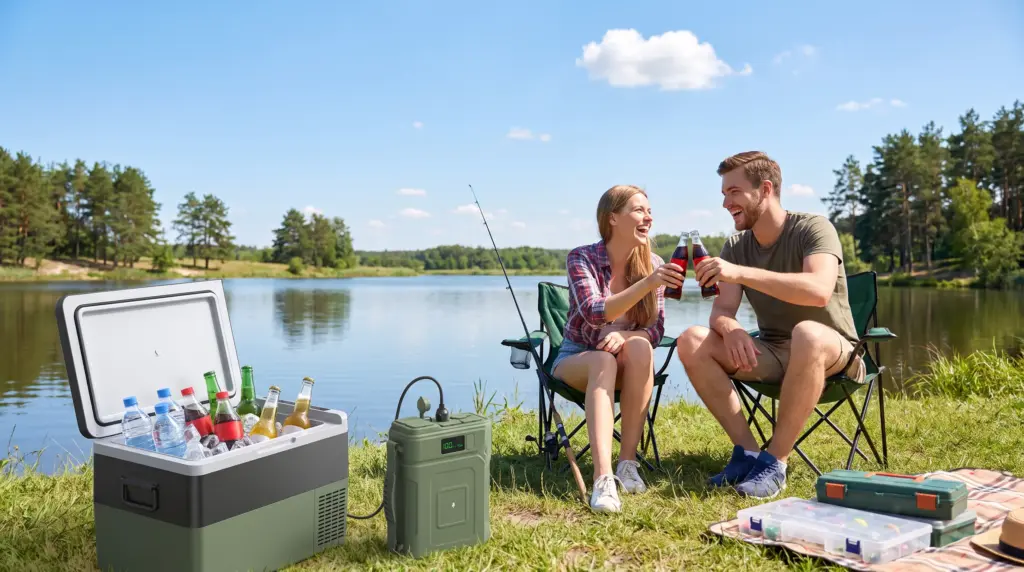
The GP45SE does not have a published waterproof rating. Keep it in a dry, protected, and ventilated location.
During use:
- Secure the battery so it cannot slide.
- Keep it above standing water.
- Protect ports from spray.
- Do not connect cables with wet hands.
- Keep saltwater away from terminals.
- Leave ventilation space around the battery.
- Do not cover it with clothing or tackle.
- Stop using it if it becomes wet, damaged, swollen, or unusually hot.
Salt can remain on a connector after water evaporates, leading to corrosion and poor contact. Inspect and maintain cables according to their manufacturers’ instructions after the trip.
Turn Battery Capacity Into a Runtime Estimate
Battery capacity is measured in watt-hours. Device consumption is measured in watts.
A simple estimate is:
Estimated runtime = Usable battery energy in Wh ÷ Average device power in W
Assume a compatible fish finder averages 25W.
If approximately 85% of the GP45SE’s 384Wh nominal capacity is available after allowing for operating limits and losses:
384Wh × 0.85 ÷ 25W = approximately 13 hours
This is an illustrative estimate, not a guaranteed runtime.
Actual performance depends on:
- Device model
- Screen brightness
- Sonar functions
- Output type
- Cable losses
- Battery temperature
- Battery condition
- Other connected devices
- Changes in device power consumption
A fish finder may consume more power when additional sonar modules, networking, or maximum screen brightness are used.
Test the complete setup before the trip. Do not use a theoretical calculation as the only basis for deciding whether a safety-critical device has sufficient power.
Prioritize Essential Devices
If battery capacity becomes limited, consider this priority:
- VHF radio or emergency communication
- Mobile phone
- Navigation equipment
- Safety lighting
- Fish finder
- Camera and optional accessories
The exact order depends on the boat and situation, but communication and safe return should come before photography or entertainment.
Following the Fish Around America’s Coasts
The species found inshore change with region, season, water temperature, migration, habitat, and local regulations.
Some fish use both inshore and offshore habitats. The following examples describe common targets rather than fixed boundaries.
Northeast and Mid-Atlantic Waters
Common targets include:
- Striped bass
- Bluefish
- Summer flounder, also called fluke
- Tautog
- Weakfish
- Black sea bass in suitable coastal areas
Productive locations may include:
- Rocky shorelines
- Sandy bottom
- Estuaries
- Jetties
- Inlets
- Piers
- Bridge structure
- Mussel and oyster beds
Striped bass and bluefish often follow baitfish. Summer flounder commonly hold near sandy bottom, channels, drop-offs, and areas where current carries food.
Southeast Atlantic Shorelines
Common targets may include:
- Red drum
- Spotted seatrout
- Flounder
- Sheepshead
- Snook in warmer southern waters
- Tarpon
- Spanish mackerel
- Seasonally available cobia
Typical habitats include:
- Salt marshes
- Tidal creeks
- Grass flats
- Mangrove shorelines
- Docks
- Bridge pilings
- Oyster beds
- Beaches
- Inlets
Sheepshead are often associated with structure, while red drum may feed around grass, marsh edges, oyster bars, and shallow flats.
Bays and Marshes Along the Gulf Coast
Popular targets include:
- Redfish
- Speckled trout
- Black drum
- Flounder
- Sheepshead
- Spanish mackerel
- Snook in suitable southern areas
- Tarpon during seasonal periods
The Gulf Coast contains extensive marshes, bays, estuaries, oyster reefs, grass flats, passes, and jetties.
Water temperature, salinity, tide, and seasonal movement can influence where fish are found.
Pacific Bays, Beaches, and Coastal Structure
Depending on location, anglers may pursue:
- California halibut
- Spotted bay bass
- Barred sand bass
- Calico bass
- Surfperch
- Rockfish in permitted areas and seasons
- Lingcod in suitable coastal areas
Pacific fishing conditions vary substantially from Southern California to the Pacific Northwest. Regulations for rockfish, lingcod, salmon, and other managed species may involve specific seasons, areas, depth restrictions, or retention rules.
Regulations Travel With the Fish
Before fishing, confirm:
- License requirements
- Open season
- Minimum size
- Maximum size, if applicable
- Daily bag limit
- Possession limit
- Protected species
- Gear restrictions
- Closed areas
- Marine protected areas
- State and federal water rules
Do not depend on an old blog post or last season’s information. Regulations can change, and rules may differ between adjacent states or water-management zones.
Pack for the Catch, the Weather, and the Trip Home
A useful gear list should cover fishing, fish handling, weather, communication, and return travel.
Build the Tackle Around the Target Species
A basic setup may include:
- Rod and reel
- Main line
- Leader material
- Hooks
- Jig heads
- Sinkers
- Swivels
- Soft-plastic lures
- Plugs
- Spoons
- Topwater lures
- Natural bait where permitted
- Tackle box
- Spare line
- Line cutter
- Pliers
The correct rod, reel, line, leader, and hook depend on the target species and fishing environment.
Open sand may allow lighter tackle, while oysters, bridge pilings, rocks, and docks may require stronger leader and better abrasion resistance.
Carry Tools That Protect Fish and Anglers
Useful handling equipment includes:
- Landing net
- Dehooking tool
- Fish gripper
- Measuring board
- Long-nose pliers
- Gloves
- Bait knife
- Cooler when keeping fish is permitted
- First-aid supplies
Know how to identify the species before keeping it. Measure the fish correctly and return protected, undersized, oversized, or out-of-season fish promptly.
Put Safety Gear Ahead of Extra Tackle
Bring:
- Properly fitted life jacket
- Whistle
- VHF radio
- Phone in a waterproof case
- First-aid kit
- Navigation light
- Headlamp
- Drinking water
- Sun protection
- Rain protection
- Emergency signaling equipment
- Required boat safety equipment
A tackle box can be replaced. Emergency communication and personal flotation cannot.
Build a Small Electronics and Power Kit
Consider packing:
- Fish finder
- GPS or chartplotter
- VHF radio
- Phone
- Camera
- Charging cables
- Spare fuses
- Compatible DC cables
- Connector covers
- Waterproof cable storage
- GP45SE
- A dry storage solution
Label similar-looking cables so they are not connected to the wrong output.
Five Minutes at the Dock Can Prevent a Bad Day
A short check before departure can prevent equipment failure, legal problems, and an unsafe return.
Check the Water
Confirm:
- Current weather
- Wind direction
- Wind speed
- Tide stage
- Current
- Visibility
- Thunderstorm risk
- Wave conditions
- Sunset time
Do not rely only on the forecast you viewed the previous evening.
Check the Rules
Confirm:
- Fishing license
- Target species
- Open season
- Size restrictions
- Bag limits
- Gear rules
- Closed areas
Make sure everyone who requires a license has one.
Check the Boat and Return Plan
Check:
- Fuel
- Engine
- Life jackets
- VHF radio
- Navigation system
- Navigation lights
- Bilge system
- First-aid kit
- Drinking water
- Return time
- Emergency contacts
Tell someone on shore:
- Where you are launching
- Where you intend to fish
- Who is onboard
- When you expect to return
- What to do if you do not check in
Check Every Powered Device
Before departure:
- Charge the GP45SE.
- Charge phones, cameras, and radios.
- Test the fish finder.
- Confirm the correct cables.
- Check fuses.
- Confirm voltage and connector compatibility.
- Secure the battery.
- Protect unused ports.
- Reserve energy for communication and lighting.
Do not wait until the boat is underway to test a new battery, cable, or adapter for the first time.
Small Planning Mistakes That Can End a Fishing Trip Early
Common mistakes include:
- Assuming inshore water is always safe
- Ignoring tide and wind
- Using outdated fishing regulations
- Bringing the wrong license
- Underestimating device startup power
- Looking only at battery capacity
- Connecting a device without checking voltage and polarity
- Allowing auxiliary electronics to drain the starting battery
- Placing a portable battery where it can get wet
- Assuming every 12V device is compatible
- Using damaged or corroded cables
- Failing to reserve power for communication
- Testing the power setup for the first time on the water
- Leaving without sharing a return plan
Most of these problems can be prevented before departure.
Where the GP45SE Adds Real Value on a Fishing Day
The GP45SE is most useful when treated as part of a planned auxiliary power system.
Potential applications include:
- Supporting a compatible fish finder
- Charging phones
- Charging cameras
- Powering suitable USB devices
- Running compatible low-power fishing lights
- Supporting a compatible bait aerator
- Providing light while organizing equipment
- Supplying power at a pier, shoreline, vehicle, or campsite
- Keeping selected equipment powered after returning to land
Its combination of DC, Big Anderson, USB-C, and USB-A outputs allows it to support different categories of compatible devices without adding an AC inverter for every load.
Direct DC or USB power can also avoid some of the conversion losses associated with changing battery DC power into AC and then back into DC through a device adapter.
The GP45SE still needs to be matched to the application. It should remain dry, securely positioned, and within its specified output limits.
Build a Better Inshore Setup, Not Just a Bigger Tackle Box
Inshore fishing is an accessible way to explore saltwater angling, but a productive day depends on more than rods and lures.
Learn how to read bays, marshes, grass flats, inlets, beaches, and coastal structure. Check the weather and tide. Understand the target species and current regulations. Carry the required safety equipment and leave a return plan with someone on shore.
Power planning belongs in the same preparation process.
Fish finders, phones, radios, cameras, lights, and aerators each have their own voltage, current, connector, and runtime requirements. Check those specifications before selecting a battery.
The Merpower GP45SE offers 384Wh of LiFePO4 energy with DC, Big Anderson, USB-C, and USB-A outputs for compatible equipment. Its role is to provide portable auxiliary power for properly matched devices.
It is not a substitute for the boat’s starting battery, a dedicated trolling-motor system, required safety equipment, or a waterproof marine installation.
A better fishing setup is not the one with the largest collection of gear. It is the one in which the tackle, boat, electronics, power, weather plan, and safety equipment work together.
Frequently Asked Questions
What Distance From Shore Counts as Inshore Fishing?
There is no single distance that applies everywhere. Inshore fishing generally refers to fishing in bays, estuaries, flats, tidal creeks, beaches, jetties, piers, and other coastal waters.
Is Inshore Fishing Suitable for Beginners?
Yes. It can be done from shore, a pier, kayak, or small boat. Beginners still need to understand weather, tides, regulations, fish handling, and basic safety.
What Is the Difference Between Inshore and Nearshore Fishing?
Inshore fishing usually takes place in protected or shallow coastal environments. Nearshore fishing often moves beyond bays and estuaries to coastal reefs, wrecks, or open water closer to land.
What Kind of Boat Is Used for Inshore Fishing?
Common choices include skiffs, bay boats, flats boats, kayaks, and small center consoles. The appropriate boat depends on water depth, weather, distance, and local conditions.
What Fish Can I Catch Inshore?
Species depend on the region. Common examples include striped bass, bluefish, flounder, redfish, seatrout, sheepshead, snook, tarpon, surfperch, and several bass species.
What Rod and Reel Should a Beginner Use?
A light- or medium-power spinning setup is suitable for many beginner applications. The exact choice should match the target species, lure weight, line, and fishing structure.
Do I Need a Saltwater Fishing License?
Requirements vary by state, age, location, and fishing method. Check the current rules for the exact place you plan to fish.
Can I Use a Fish Finder for Inshore Fishing?
Yes. A fish finder can show depth, bottom changes, structure, and possible fish activity. It should complement observation and local knowledge rather than replace them.
How Do I Power a Fish Finder for a Full Day?
Check the fish finder’s voltage, average power, connector, and expected operating time. Select a compatible battery, estimate runtime, and test the complete setup before departure.
Can the GP45SE Power a Fish Finder?
It may power a compatible model if the fish finder’s voltage, current, connector, polarity, and power requirements match the GP45SE output. Compatibility must be confirmed for the specific device.
Can the GP45SE Run a Trolling Motor?
The GP45SE is positioned as a portable auxiliary power pack. A trolling motor may require sustained high current and much more energy. Do not connect one without complete electrical verification and manufacturer approval.
Is the GP45SE Waterproof?
No published waterproof rating should be assumed. Keep the battery dry, protect its ports from spray, and place it in a secure, ventilated location.
How Should I Protect a Battery From Saltwater?
Keep it above standing water, secure it against movement, cover unused ports, avoid wet connections, and inspect connectors for salt and corrosion after the trip.
How Can I Estimate Battery Runtime?
Divide estimated usable battery energy in watt-hours by the device’s average power in watts. The result is only an estimate and should be verified with the actual equipment.