



Table of Contents
When shopping for portable charging solutions, you’ll often see two terms used interchangeably: power bank and portable charger.
Are they the same thing?
Is one better than the other?
Or is the difference just marketing language?
If you’re confused, you’re not alone. This guide explains the real differences between a power bank and a portable charger, how they’re used, and how to choose the right one for your needs.
Quick Answer: Is a Power Bank Different from a Portable Charger?
In most cases, a power bank and a portable charger are the same type of device. Both store electrical energy in a battery and allow you to charge devices without a wall outlet.
However, in practical usage:
The term “portable charger” is commonly used for smaller, phone-focused chargers.
The term “power bank” is often used for higher-capacity models with more output options.
So while the technology is similar, the intended use and capability can differ significantly.
Quick Answer: Is a Power Bank Different from a Portable Charger?
In most cases, a power bank and a portable charger are the same type of device. Both store electrical energy in a battery and allow you to charge devices without a wall outlet.
However, in practical usage:
The term “portable charger” is commonly used for smaller, phone-focused chargers.
The term “power bank” is often used for higher-capacity models with more output options.
So while the technology is similar, the intended use and capability can differ significantly.
1. What Is a Portable Charger?
A portable charger is a compact battery-powered device designed primarily to recharge smartphones, earbuds, smartwatches, and other small electronics.
Typical Characteristics
Capacity: 5,000mAh – 20,000mAh
Outputs: USB-A or USB-C
Power output: 10W – 30W
Small and lightweight
Designed for everyday carry
Common Use Cases
Daily commuting
Travel days
Backup phone charging
Airports and long flights
Emergency phone recharge
Portable chargers are built for convenience and portability. They are ideal for users who simply want to keep their phone alive throughout the day.
1. What Is a Portable Charger?
A portable charger is a compact battery-powered device designed primarily to recharge smartphones, earbuds, smartwatches, and other small electronics.
Typical Characteristics
Capacity: 5,000mAh – 20,000mAh
Outputs: USB-A or USB-C
Power output: 10W – 30W
Small and lightweight
Designed for everyday carry
Common Use Cases
Daily commuting
Travel days
Backup phone charging
Airports and long flights
Emergency phone recharge
Portable chargers are built for convenience and portability. They are ideal for users who simply want to keep their phone alive throughout the day.
2. What Is a Power Bank?
A power bank performs the same basic function—storing energy for later use—but is often designed with larger capacity and expanded capabilities.
Typical Characteristics
Capacity: 20,000mAh – 100,000mAh+
Outputs: USB + DC (12V/24V) + sometimes AC
Higher wattage output
Designed for multi-device use
More suitable for outdoor or professional scenarios
Common Use Cases
Camping trips
Fishing and boating
Road travel
Remote work
Emergency backup
Powering equipment beyond smartphones
While many small chargers are technically “power banks,” the term today usually implies greater capacity and versatility.
3. Power Bank vs Portable Charger: Direct Comparison
Here is a side-by-side comparison to clarify the practical differences.
| Feature | Portable Charger | Power Bank |
|---|---|---|
| Primary Purpose | Phone charging | Multi-device power |
| Capacity | Low–Medium | Medium–High |
| Output Types | USB only | USB + DC (sometimes AC) |
| Device Support | Phones, earbuds | Phones, laptops, fridges |
| Runtime | Short | Extended |
| Outdoor Use | Limited | Ideal |
| Price Range | Budget | Mid to premium |
The key difference lies not in technology, but in power delivery capability and intended use.
3. Power Bank vs Portable Charger: Direct Comparison
Here is a side-by-side comparison to clarify the practical differences.
| Feature | Portable Charger | Power Bank |
|---|---|---|
| Primary Purpose | Phone charging | Multi-device power |
| Capacity | Low–Medium | Medium–High |
| Output Types | USB only | USB + DC (sometimes AC) |
| Device Support | Phones, earbuds | Phones, laptops, fridges |
| Runtime | Short | Extended |
| Outdoor Use | Limited | Ideal |
| Price Range | Budget | Mid to premium |
The key difference lies not in technology, but in power delivery capability and intended use.
4. Why the Terms Are Used Interchangeably
From a technical perspective, both devices contain:
Lithium battery cells
A battery management system (BMS)
Charging circuitry
Output regulation
The reason the terminology differs is primarily marketing.
Retailers often use:
“Portable charger” for small, everyday products
“Power bank” for larger-capacity or professional-grade products
Consumers then adopt these distinctions naturally.
5. Capacity: The Real Differentiator
Capacity is the biggest functional difference.
Understanding mAh vs Wh
Most portable chargers list capacity in mAh (milliamp-hours).
However, energy is more accurately measured in watt-hours (Wh).
Example:
20,000mAh × 3.7V ≈ 74Wh
50,000mAh × 3.7V ≈ 185Wh
A 50,000mAh power bank holds more than double the usable energy of a 20,000mAh portable charger.
This increase in energy changes what the device can realistically power.
5. Capacity: The Real Differentiator
Capacity is the biggest functional difference.
Understanding mAh vs Wh
Most portable chargers list capacity in mAh (milliamp-hours).
However, energy is more accurately measured in watt-hours (Wh).
Example:
20,000mAh × 3.7V ≈ 74Wh
50,000mAh × 3.7V ≈ 185Wh
A 50,000mAh power bank holds more than double the usable energy of a 20,000mAh portable charger.
This increase in energy changes what the device can realistically power.
6. Output Options: Why It Matters
The second major difference is output type.
USB Output
Best for:
Phones
Tablets
Cameras
Small electronics
Efficient and convenient, but limited in power.
6. Output Options: Why It Matters
The second major difference is output type.
USB Output
Best for:
Phones
Tablets
Cameras
Small electronics
Efficient and convenient, but limited in power.
DC Output (12V / 24V)
Found more commonly in higher-capacity power banks.
Best for:
Portable fridges
CPAP machines
LED lighting systems
Routers
Heated clothing
Dashcams
DC output is highly efficient because it avoids energy conversion loss.
AC Output
Some larger power banks include an inverter to provide AC.
Pros:
Can use traditional chargers
Cons:Energy loss (15–25%)
Increased size
Heat generation
For many outdoor uses, DC is more practical than AC.
7. Which Devices Can Each Power?
Let’s look at realistic examples.
Portable Charger (20,000mAh Example)
Phone: 4–6 full charges
Tablet: 2–3 charges
Laptop: Often insufficient
Cannot realistically power:
Fridges
CPAP machines
12V appliances
Power Bank (50,000mAh Example)
Phone: 8–12 charges
Laptop: 1–2 full charges
Portable fridge: 6–12 hours (depending on conditions)
CPAP: 1 full night (DC mode)
LED lighting: 15–30 hours
The increase in capability is significant.
8. Portability vs Power
Portable chargers win in:
Size
Weight
Airline compliance
Pocket convenience
Power banks win in:
Runtime
Device flexibility
Outdoor reliability
Emergency preparedness
Choosing between them depends entirely on your use case.
9. Travel and Airline Considerations
Airlines typically restrict carry-on lithium batteries to:
Under 100Wh (without approval)
This means:
Most 20,000mAh portable chargers are flight-safe
Many 50,000mAh power banks exceed airline limits
If you fly frequently, a portable charger may be more practical.
10. When a Portable Charger Is Enough
Choose a portable charger if:
You only need phone backup
You commute daily
You fly often
You prioritize compact size
You want budget-friendly options
For most urban users, this is sufficient.
11. When a Power Bank Makes More Sense
Choose a power bank if:
You go camping
You run a portable fridge
You use a CPAP machine
You need multi-device support
You want emergency power backup
Outdoor and off-grid scenarios benefit significantly from larger capacity and DC output capability.
12. Beyond the Basics: High-Capacity Outdoor Power Banks
Modern outdoor power banks go beyond traditional phone charging. Some models are designed with:
12V DC ports
Cigarette lighter sockets
Multiple voltage outputs
Advanced battery management systems
LiFePO4 battery chemistry for enhanced safety
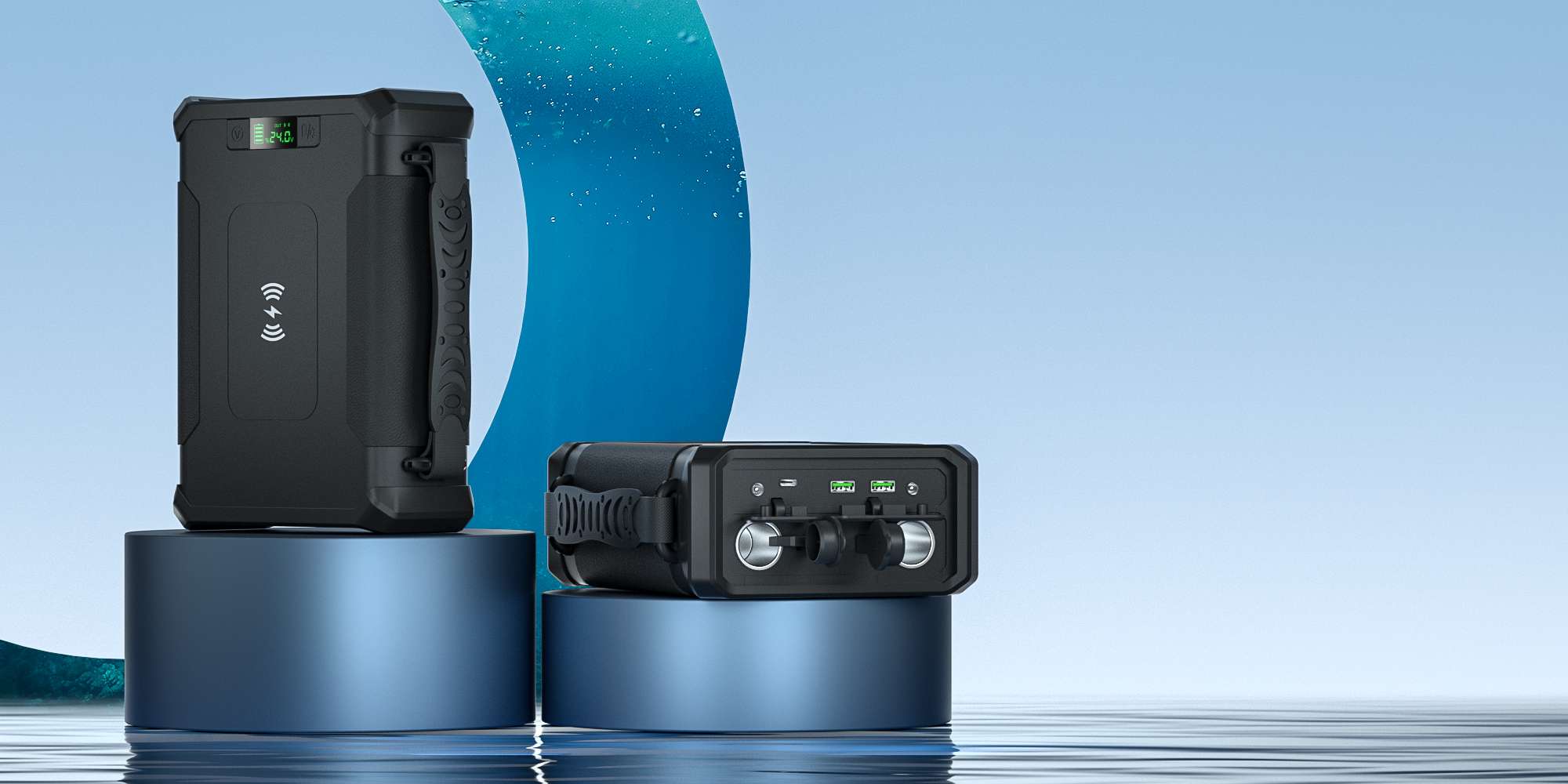
For example, outdoor-focused units in product lines such as the Merpower GP Series are engineered for multi-device field use rather than just mobile phone charging.
Models like:
GP16 (compact DC + USB)
GP20 (12V output for camping setups)
GP50 (high-capacity, multi-output design)
demonstrate how modern power banks extend beyond the “portable charger” category.
13. Efficiency and Runtime: Why Output Type Matters
Using DC output instead of AC inversion can improve runtime by:
10–25% depending on load
For devices like:
Fridges
CPAP machines
Lighting
this difference can determine whether your battery lasts overnight.
Portable chargers rarely offer DC outputs, limiting their application.
13. Efficiency and Runtime: Why Output Type Matters
Using DC output instead of AC inversion can improve runtime by:
10–25% depending on load
For devices like:
Fridges
CPAP machines
Lighting
this difference can determine whether your battery lasts overnight.
Portable chargers rarely offer DC outputs, limiting their application.
14. Price Differences
Portable chargers:
Affordable
Mass-market
Commodity products
Power banks:
Higher cost
More engineering
Higher-grade battery systems
More safety controls
Price reflects capability.
15. The Psychology Behind the Naming
Interestingly, consumer perception plays a role.
“Portable charger” feels:
Casual
Simple
Everyday
“Power bank” feels:
Stronger
Higher capacity
More serious
Brands leverage this perception strategically.
16. Frequently Asked Questions
Are power banks more powerful than portable chargers?
Often yes, but not always. It depends on capacity and output type.
Can a portable charger power a laptop?
Only if it supports high-wattage USB-C PD. Most cannot handle extended laptop use.
Is a power bank heavier?
Generally yes, due to higher capacity.
Which lasts longer?
Higher-capacity power banks last significantly longer.
Are they safe?
Both are safe when equipped with proper BMS protection.
17. Final Verdict: Which Should You Choose?
If your only concern is keeping your phone alive during the day, a portable charger is all you need.
If you need to power:
Multiple devices
Outdoor equipment
12V appliances
Medical devices
Emergency systems
then a higher-capacity power bank is the smarter investment.
The name matters less than the capacity, output type, and intended use.
Conclusion
The debate between power bank vs portable charger is less about technical difference and more about capability.
They share the same core function—but differ dramatically in scale and application.
Understanding your energy needs, device requirements, and use environment will determine which one is right for you.
For everyday charging, portable chargers are perfect.
For real-world power beyond smartphones, a properly designed power bank is in a completely different category.